Non-Important Protocol Deviation Rate
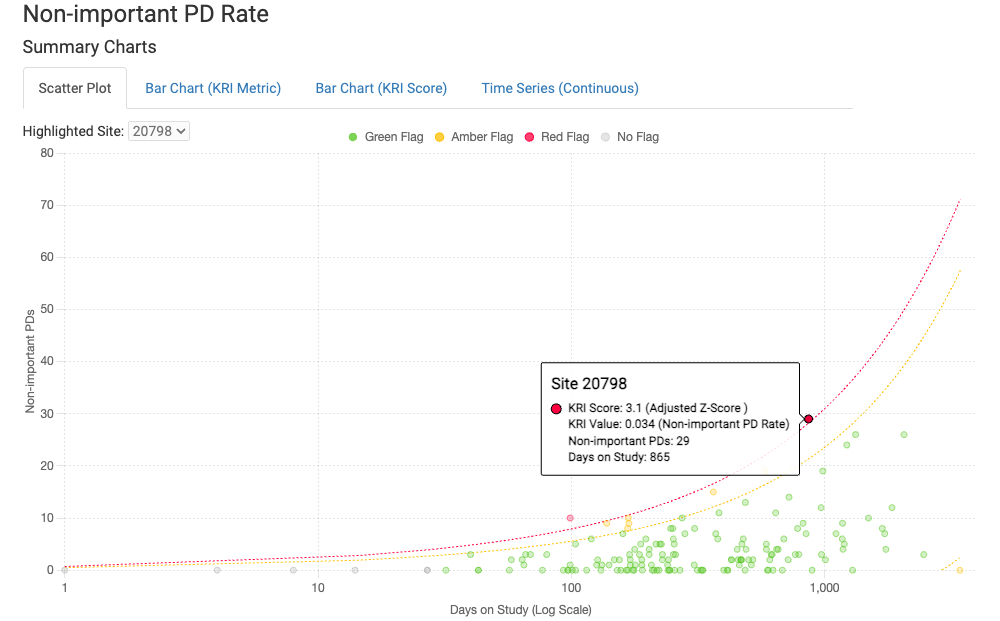
Non-Important Deviation Rate: this KRI flags sites and countries with unexpectedly high or low Non-IPD rates which are calculated as the total number of Non-IPDs for the site/country relative to the cumulative number of days participants have been on study for the site/country.
Steps to Perform the Review
-
In the KRI Report by Country, review the PD Reporting Rate scatter plot for outlier countries. Before confirming action is required at the country level, assess if the signal is truly country level or if a particular site/sites are resulting in the country level signal.
-
In the KRI Report by Site, review the Non-IPD Reporting Rate scatter plot for outlier sites.
Site 20798 in the screenshot below is an outlier with an unexpectedly high non-IPD rate.
For High Outliers
Briefly review the non-important protocol deviations to determine if there is a trend in a particular type of deviation. This would indicate a need for targeted retraining in the observed area.
For Low Outliers
This signals a potential deficit in reporting deviations (note this is only able to identify potential deficiency in reporting within the deviation documentation system e.g., CTMS; it cannot identify potential deficiency in reporting deviations to the IRB). These sites would be escalated to ensure all observable deviations have been documented in CTMS and that the site has reported them to the IRB. Also of note for low outlier sites – consider how many subjects have been enrolled by the site, more subjects may contribute to higher risk of under-reporting due to higher site workload.