Screen Failure Rate
This KRI flags sites and countries with a high rate of screen-failed subjects relative to the total number of subjects screened at the site/country. High outliers indicate potential issues in site screening process while low outliers may indicate too-good-to-be-true patterns (e.g., did the patients truly all qualify for study, etc.).
Total counts should always be kept in mind as sites/countries with very small numbers may not warrant escalation e.g., 2/4 subjects screen failed is 50% and may be a high outlier, but 2 subjects is not a trend and does not necessarily justify further action at that timepoint. The study design and participant population should also be considered – in some studies the screen failure rate may be expected to be higher due to rare disease or challenges with lab-related criteria. However, keep in mind that this approach is comparing sites within the same study who should all be following the same criteria, so participants should be relatively homogenous (not always the case, but generally).
Steps to Perform the Review
-
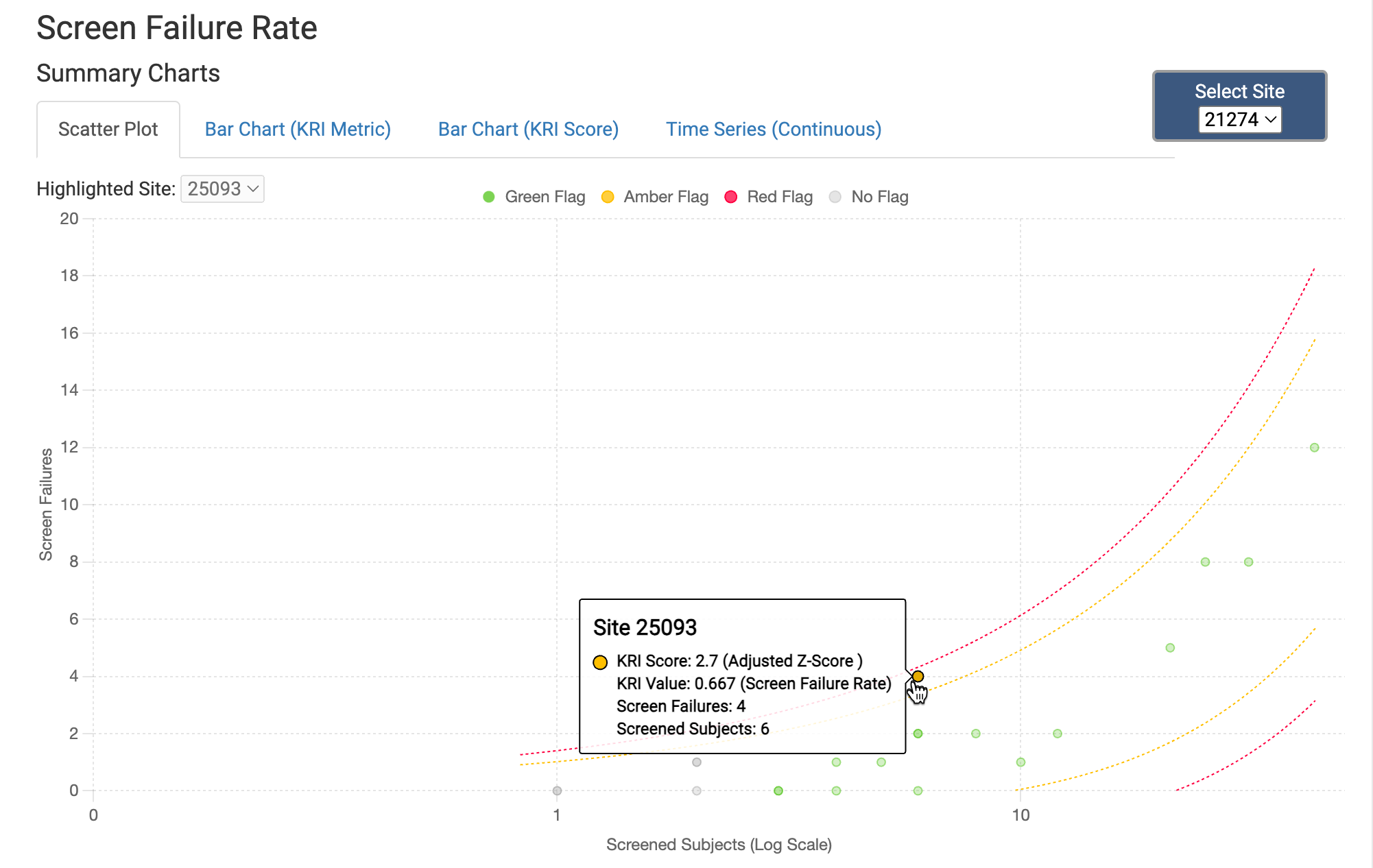
In the KRI Report by Site, review the Screen Failure Rate scatter plot for outlier sites in amber/red.
Here site 25093 has a 67% screen failure rate with 4/6 screened subjects screen failed.